
Most expansion joint damage in buildings starts with something under the cover letting go: a fixing loses its grip, the levelling bed under the frame cracks or was never solid, or the cushion that seats the plate goes missing. The first sign is a rattle. Find which cause it is before re-tightening anything, because each needs a different repair.
A damaged expansion joint rarely fails all at once. In the signs of expansion joint failure, the rattle comes first: it is the earliest warning and the cheapest moment to act, and that piece says what to do this week. This one goes underneath the cover. It covers what keeps a plate silent, the six things that damage it, how to tell them apart on site, and what to check at installation so the damage never starts.
What keeps an expansion joint cover silent
A floor joint cover is quiet because four things hold it, one on top of the other. If any one lets go, the plate can move against its frame, and every wheel that crosses it makes a sound.
- The levelling bed. A high-strength mortar bed of at least 40 N/mm², fully cured before anything is fixed to it. The frame sits on it, so everything above depends on it. What the joint needs from the slab covers the rebate and the bed in detail.
- The frame fixings. Anchors through the frame’s own holes into that bed, tightened to the torque the method statement gives for the system.
- The seat between plate and frame. Plate systems carry a cushion. The MegAtec 310 has a sound damper under the plate and the MegAtec 370 a silicone cord, both there to stop the plate sounding underfoot. On the MegAtec 340, a centre mechanism keeps the plate centred over the gap: a spacer, a centring bar and a self-locking nut.
- The level. The top of the bed plus the frame height should equal the finished floor level. The cover then sits flush, and wheels roll over it rather than strike its edge.
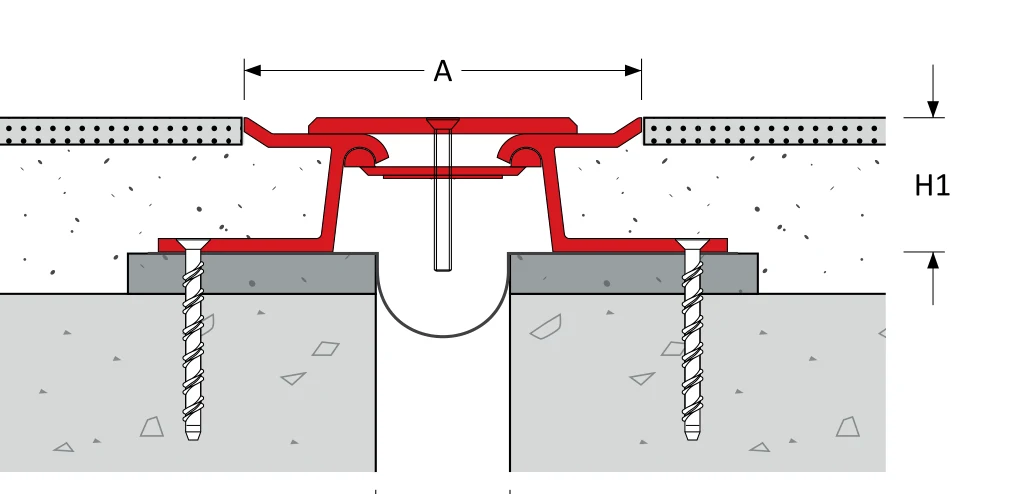
What causes expansion joint damage: six ways it starts
1. A fixing that has lost its torque. The commonest. Every crossing flexes the plate a little, and over months that works a fixing loose. On site the fixing turns, then tightens again. The hole is still sound, which makes this the cheap case.
2. A hole that was never cleared. The hole for each anchor is drilled deeper than the anchor is long, so the drilling dust has somewhere to go, and it should be cleared before the anchor goes in. If it wasn’t, the anchor seats against its own dust, and the torque the installer read was never real. It loosens early, and often it never tightens properly again.
3. The wrong anchor for what is underneath. Where waterproofing is already in place under the frame, the method statement calls for a gun-applied resin anchor at each hole instead of a plain mechanical fixing. A mechanical anchor where resin was specified is a fixing other than the one designed for that spot. It is one of the first things to check on a podium or roof joint that rattles.
4. A bed that was not ready, or not there. The bed may have been fixed to before it had cured, mixed weaker than 40 N/mm², laid narrower than the blockout, or left with voids under the frame. An anchor is only as good as what it is fixed into. The sign is a fixing that tightens while the frame still moves, a hollow note when the frame line is tapped, or cracking in the bed along the frame edge.
5. A seat that has gone. The damper or cord was never fitted, or was crushed and not replaced, or a 340 has lost part of its centre mechanism. The plate now meets the frame metal on metal, and the result is the dry click people describe as a rattle, even with every fixing tight.
6. A frame set to the wrong height. If the cover stands proud of the finish, every wheel strikes its leading edge. If it sits low, every wheel drops onto it. Both hammer the fixings, so a height fault often shows up first as cause 1, coming back however many times the fixings are tightened.
One more cause of damage is not a fixing problem at all: traffic the cover was never rated for. A plate under heavier wheels than its rating flexes more than it was designed to, and no amount of tightening fixes that. Replacing a failed expansion joint deals with joints that were specified wrongly.
How to find which cause it is, on site
This takes one person, a roll of tape, a straight edge and the tool on the method statement. Allow about an hour for a typical run.
- Find the noisy positions. Push a trolley along the joint and mark every point that sounds. Note whether it is one spot, one length or the whole run. One spot points to a fixing; a whole run points to a cause that was there from the start, such as the bed, the height or the seat.
- Rock the plate. At each mark, stand on one edge of the cover. If the movement is at a fixing, start with the fixings. If every fixing is tight and the plate still moves, look at the seat and the bed.
- Try each fixing at the marked positions. Record each one as tight, turns then tightens, or spins.
- Tap along the frame line with the handle of a hammer. A hollow note, or cracking in the bed beside the frame, means the bed.
- Have one plate length lifted where the method statement allows it, and look for the damper, cord or centring parts.
- Lay the straight edge across the joint and check that the cover is flush with the finish on both sides.
How a damaged expansion joint is repaired
| What you find | What it means | The repair |
|---|---|---|
| Fixings turn, then tighten | The torque has been lost; the holes are sound | Re-tighten to the method statement’s figure, then re-check the same positions a month later |
| A fixing spins and never tightens | The hole has worn or was never clean | A new fixing in a fresh, cleared hole beside it, or a resin anchor |
| Several fixings spin along one length | The bed or slab edge has failed there | Lift the length, break out the bed, re-bed at 40 N/mm², let it cure, then refix. A substrate repair, not a re-tighten |
| All fixings tight, plate still clicks | The seat has gone | Refit the damper, cord or centre mechanism |
| Cover proud of or below the finish | The frame was set at the wrong height | Re-set the frame on a corrected bed |
| A lip, a lifted end, or a cover that has crept along the joint | Past the rattle stage | See replacing a failed expansion joint |
Repairs in the last three rows mean lifting the joint in an occupied building. How we survey and do that work is on expansion joint treatment and repair.
How to prevent it: checks before handover
Every cause on that list is decided before the plates go on. For the site engineer or consultant signing off a joint, these are the checks that keep it quiet. How a building expansion joint is installed gives the full sequence.
- Bed: at least 40 N/mm², fully cured before the frames are fixed, no narrower than the blockout width, and the same height along the whole run.
- Height: top of bed plus frame height equals the finished floor level.
- Holes: marked through the frame’s own holes, drilled with the frame lifted off, drilled past the anchor’s length, and cleared before fixing.
- Anchors: mechanical into bare concrete; resin where waterproofing is already under the frame.
- Torque: to the method statement’s figure for the system, recorded length by length.
- Seat: the damper, cord or centre mechanism fitted on every length before the plates close.
- Protection: the joint covered against site traffic until the finishes around it are complete.
Quick answers
Is a rattling expansion joint dangerous?
Not straight away: a joint that rattles is still closing the gap. Every crossing works the fixing further, though, and the hole gets larger. That is how a rattle becomes a lifted plate and then a tripping hazard. It is cheapest to fix at the rattle stage.
Can a loose expansion joint cover just be re-tightened?
Only if the fixing turns and then tightens. That means the hole is sound, and re-tightening to the method statement’s torque is the repair. If it spins and never tightens, the hole or the bed has gone, and tightening harder strips it further.
Who should repair a damaged expansion joint?
Someone working from the method statement for that system, who will check the bed and the seat as well as the fixings. A re-tighten alone treats only the commonest cause. We survey before we quote: see expansion joint treatment and repair.